

One-click payments with Klarna Presentation API (Partner orchestrated)
Charge a returning customer's saved Klarna option in a one-click, customer-initiated transaction using the Klarna Presentation API (no SDK), where you orchestrate the charge. Create the Klarna payment request with the Klarna Customer Token, then finalize through Solidgate with the klarna_network_session_token.
8 min read
This guide explains how to charge a returning customer's saved Klarna option in a one-click, customer-initiated transaction using the Klarna Presentation API (no Web SDK), where you orchestrate the charge. The customer is at checkout and has a stored Klarna Customer Token, so Klarna can be pre-selected as a one-click "Saved" option.
Because the Presentation API is server-side, you submit the Klarna Customer Token directly to restore the saved option — there is no token exchange. You then create Klarna's payment request yourself with the Klarna Customer Token and the selected
payment_. Klarna returns a klarna_ via the completion webhook, which you forward to Solidgate to finalize the charge.Integration requirement
Charge credential: Klarna Customer Token only. Because you initiate the charge, this flow is authorized on the Klarna Customer Token only. The Solidgate token applies only when Solidgate initiates the charge — see One-click payments with Klarna Presentation API (Solidgate orchestrated).
Full presentation API setup
For the full Presentation API setup (rendering Klarna server-side from the returned assets, payment-request lifecycle), follow Build checkout form with Klarna Presentation API. This page covers only the saved-option specifics. To compare all tokenized flows, see the Tokenized payments overview.
Prerequisites
Before you integrate, check that you meet the following prerequisites:
- 1.Ensure that you have Klarna enabled with Solidgate.
- 2.A stored Klarna Customer Token for the customer, issued with the
payment:customer_scope (see Create a Klarna Customer Token).present - 3.Confirm you have access to the Klarna Partner Portal with an API key able to call the Klarna Payment Presentation API and the Klarna Payment Request API.
- 4.Confirm that you have registered webhooks for
payment.events following the Webhooks guidelines.request. state-change. completed - 5.Add Terms and Conditions covering saved payment methods.
Integration overview
- 1.Call the Klarna Payment Presentation API server-side with the stored Klarna Customer Token in the
Klarna-Customer-Tokenheader — Klarna returns the customer's saved option and itspayment_.option_ id - 2.Render Saved (pre-selected) and Pick plan in your payment selector.
- 3.The customer selects the saved option; you call Klarna's Create Payment Request with the Klarna Customer Token, the
payment_, and aoption_ id customer_.interaction_ config - 4.If Klarna requires a step-up (based on risk), redirect the customer to the returned
payment_to complete the Klarna Purchase Journey. Otherwise the request completes immediately.request_ url - 5.Klarna fires the
payment.webhook with a (new) Klarna Network Session Token.request. state-change. completed - 6.You forward the (new) Klarna Network Session Token to Solidgate to finalize the charge.
- 7.Solidgate approves the order; you redirect the customer to your confirmation page.
sequenceDiagram
autonumber
participant C as Customer
participant P as Partner
participant K as Klarna
participant AP as Solidgate
C->>P: Visits checkout page
P->>K: Call Presentation API<br/>GET payment/presentation
Note over P,K: Header: Klarna-Customer-Token
K-->>P: Return payment methods and instruction
Note over K,P: payment_option_id
P->>P: Display Klarna payment methods
C->>P: Click Klarna payment button
P->>K: Create payment request<br/>POST /v2/payment/requests
Note over P,K: Header: Klarna-Customer-Token<br/>payment_option_id
alt STEP_UP_REQUIRED
K-->>P: Return payment_request_url
P->>C: Redirect to payment_request_url
C->>K: Complete Klarna purchase journey
end
K-->>P: Payment request completed event (webhook)
Note over K,P: (new) klarna_network_session_token
P->>AP: Confirm payment
Note over P,AP: (new) klarna_network_session_token
AP-->>P: Order completed notification
P-->>C: Display confirmation message
Integration details
Call the Klarna Payment Presentation API (
GET payment/) from your server with the stored Klarna Customer Token in the Klarna-Customer-Token header. No exchange to a Klarna Network Session Token is needed for this server-side flow.SHELL
1
2
3
4
5
6
7
8
9
curl -G https://api-global.test.klarna.com/v2/accounts/{partner_account_id}/payment/presentation \
  -H 'Authorization: Basic <API key>' \
  -H 'Content-Type: application/json' \
  -H 'Klarna-Customer-Token: krn:network:eu1:live:customer-token:[...]' \
  --data-urlencode 'locale=en-US' \
  --data-urlencode 'amount=11800' \
  --data-urlencode 'currency=USD' \
  --data-urlencode 'intent=PAY'
With a Klarna Customer Token context present, the response includes a
saved_ (in addition to the default payment_) and the PRESELECT_ instruction. Render the Saved option before the default option and pre-select it; the default option becomes the Pick plan entry. Forward the saved option's payment_ to the payment request.The recommended presentation when a Klarna Customer Token is available:
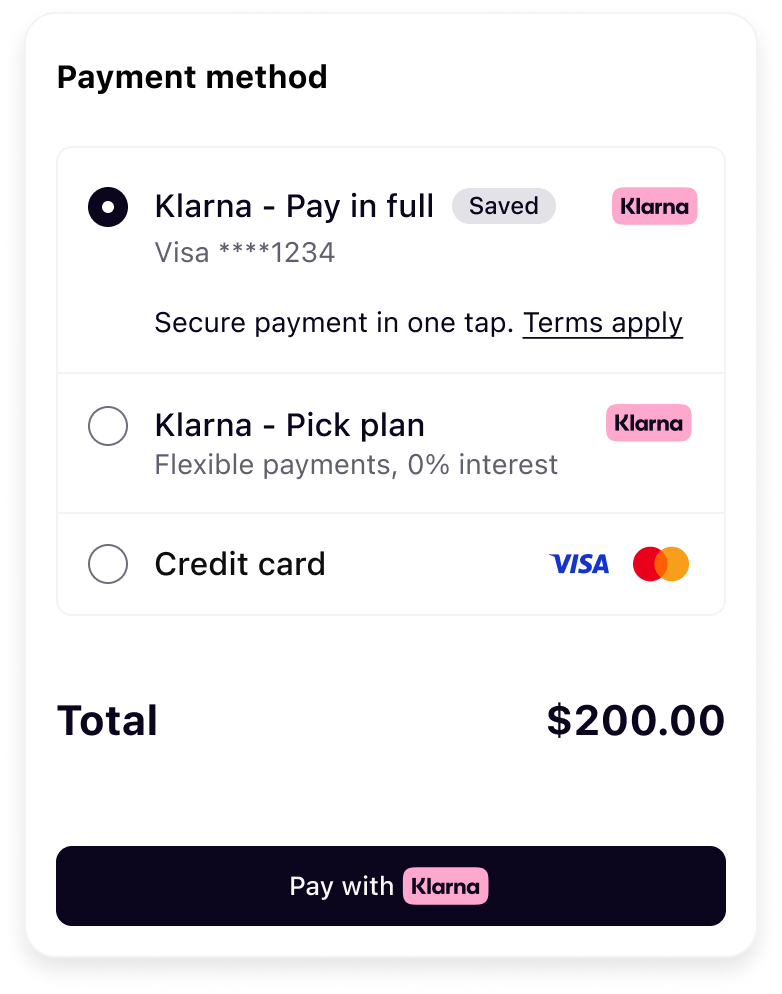 | 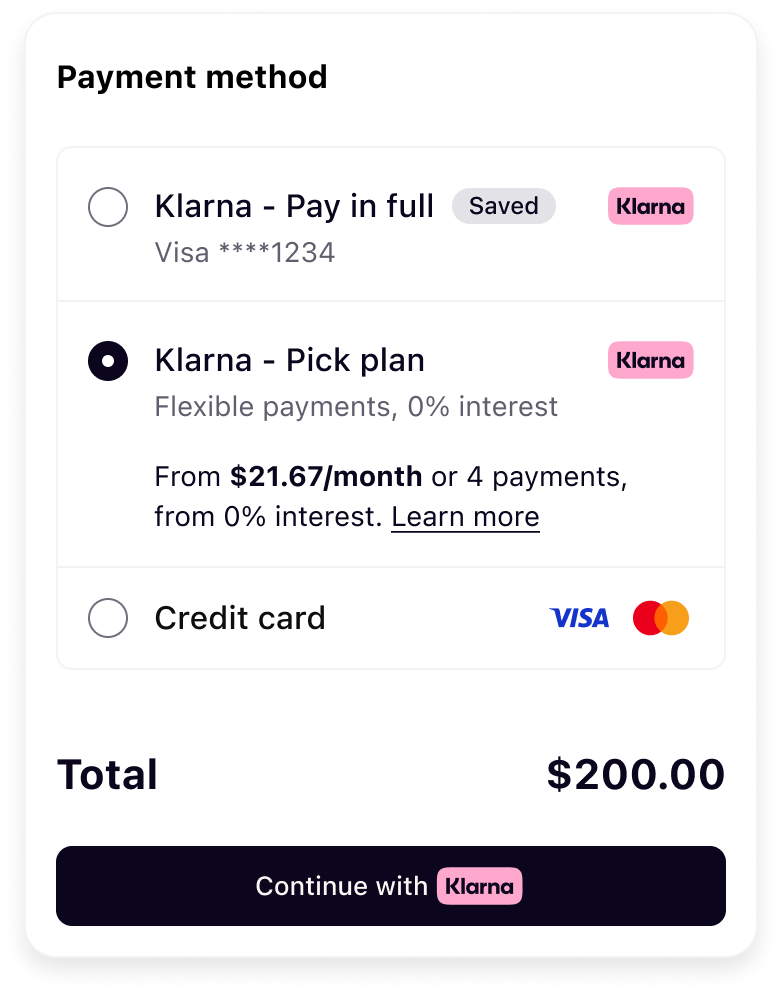 |
| Saved Klarna option (pre-selected) | Pick Plan selected |
Integration requirement
The Klarna Customer Token is required to present the saved option. Render the assets and localized texts returned by the Payment Presentation API verbatim — prioritize
saved_ over payment_ whenever both are present.Chain session token from Boost
If you already hold a Klarna Network Session Token obtained when the customer interacted with a Boost feature (for example On-site messaging or Sign in with Klarna) earlier in the checkout, chain it: call the Payment Presentation API with both that session token in the
Klarna-Network-Session-Token header and the Klarna Customer Token in the Klarna-Customer-Token header. This links the new personalized session to the existing one, preserving session continuity across the checkout.When the customer selects the saved option, create the Klarna payment request from your server, passing the Klarna Customer Token, the selected
payment_, and a customer_. For a payment:customer_ token the charge may complete immediately or require a short step-up, depending on Klarna's risk assessment — include the customer_ so Klarna can drive the Klarna Purchase Journey when a step-up is needed.| Field | Presence | Description |
|---|---|---|
klarna_ | required | The stored Klarna Customer Token. This is the only charge credential for a Partner-orchestrated charge. |
payment_ | required | The saved option's payment_ from the presentation — drives the one-click "Saved" experience. |
currency | required | Currency in ISO 4217 format. |
amount | required | Total charge amount in non-negative minor units (e.g. $118.00 = 11800). |
customer_ | required | URL Klarna returns the customer to after a step-up Klarna Purchase Journey. Include it so a step-up can be completed if Klarna requires one. |
BASH
1
2
3
4
5
6
7
8
9
10
curl -X POST https://api-global.test.klarna.com/v2/payment/requests \
  -H 'Authorization: Basic <API key>' \
  -H 'Klarna-Customer-Token: krn:network:eu1:live:customer-token:[...]' \
  -H 'Content-Type: application/json' \
  -d '{
    "currency": "USD",
    "amount": 11800,
    "payment_option_id": "S0xBUk5BXzE3NzI3MDY2MTI2ODg=",
    "payment_request_reference": "one-click-ref-123",
"customer_interaction_config": {Klarna's Create Payment Request response tells you whether a step-up is needed:
- No step-up — the payment request completes immediately. Continue to retrieve the (new)
klarna_.network_ session_ token - Step-up required — Klarna returns
state_and the payment request moves tocontext. customer_ interaction. payment_ request_ url IN_. Because this is a server-side flow (no Web SDK), redirect the customer to thePROGRESS payment_to complete the Klarna Purchase Journey. Once the customer finishes, they return to yourrequest_ url return_and the payment request transitions tourl COMPLETED.
Either way, the flow converges on the
payment. webhook below.Klarna issues a (new)  for resilience.
klarna_ once the payment request reaches COMPLETED. Retrieve it by subscribing to the payment. webhook (required); you may additionally call the Read Payment Request API for resilience.Integration requirement
The
klarna_ is valid for only 1 hour and must be forwarded to Solidgate within this time frame to finalize the authorization.Forward the (new)
klarna_ to Solidgate to finalize the charge. Solidgate authorizes with Klarna and returns the outcome. The request/response contract is owned by Solidgate; only the Klarna-specific token you must include is shown here.BASH
1
2
3
4
5
6
7
8
9
10
curl -X POST https://api.acquiring-partner.com/payment \
  -H "Content-Type: application/json" \
  -d '{
    "amount": 11800,
    "currency": "USD",
    "payment_methods": {
      "klarna": {
        "klarna_network_session_token": ""
      }
}| Outcome | What it means | Next step |
|---|---|---|
APPROVED | Klarna authorized the charge. | Display the confirmation page and record the successful charge. |
DECLINED | Klarna did not authorize the charge. | Surface a retry/alternative payment to the customer. |
Integration requirement
Once any required step-up is complete and you forward the (new)
klarna_, Solidgate returns APPROVED or DECLINED. A saved-option charge often completes without a step-up, but Klarna may still require one based on risk — always handle the step-up branch above. If you instead present Klarna as a one-time payment (no Klarna Customer Token), follow Build checkout form with Klarna Presentation API.Related articles
API & SDK references
Jump to section...