
Payment Authorization for Hosted Checkout integration
Integrate Klarna's Payment Authorize API for hosted checkout and embedded elements. This guide covers backend implementation for handling authorization results, step-up flows, and finalizing payments.
143 min read
This guide is part of the Payment Authorization flow for hosted checkout and embedded elements integration path. It covers the backend implementation — what the Acquiring Partner's server does after the customer interacts with the Klarna payment form on the frontend.
Where this fits in the integration flow:
- Payment Presentation — Your frontend presents Klarna payment methods and collects the customer's selection (previous step)
- Authorize the payment (backend) — Your backend receives the frontend request and calls Klarna's Payment Authorize API (this step)
- Manage payment transactions — Capture, refund, or cancel authorized payments (next step)
This guide is a continuation of the Payment Presentation guide and focuses on the server-side authorization flow.
What you'll implement:
- A backend endpoint that receives authorization requests from your frontend
- Integration with the authorizePayment
 API
API - Handling of all authorization outcomes (
APPROVED,STEP_UP_REQUIRED,DECLINED)
Before implementing the backend endpoint, ensure you have:
- A working Payment Presentation implementation — your frontend can present Klarna payment methods and collect the customer's selection
- The ability to collect payment context from the Partner (
amount,currency,supplementary_purchase_data,klarna_network_session_token,klarna_network_data) - A Partner Account onboarded with Klarna
- An API Key associated with your Partner Account
- A Klarna webhook endpoint configured to receive Klarna events
Backend role in this flow
Your backend's role: Your backend receives the authorization request from the frontend, calls Klarna's authorizePayment API, and returns the result so the frontend can proceed accordingly.
API, and returns the result so the frontend can proceed accordingly.The backend authorization flow starts after the customer selects a Klarna payment method in your checkout. Your frontend triggers the
initiate callback, which calls your backend. Your backend then forwards the request to Klarna and returns the result.The integration process consists of the following key steps:
- 1.Your frontend triggers the
initiatecallback: The Klarna web SDK calls your configured callback when the customer initiates a payment authorization. - 2.Your backend receives the authorization request: Accept
klarna_network_session_tokenandpayment_option_idfrom your frontend - 3.Your backend calls the authorizePayment endpoint: Forward the payment context to Klarna
- 4.Your backend handles authorization results: Process
STEP_UP_REQUIRED,APPROVED, orDECLINEDoutcomes and return the result to your frontend - 5.Your frontend configures
initiationMode: Control how the Klarna Web SDK launches the Klarna Purchase Journey for step-up - 6.Your backend monitors step-up completion: Detect when the customer completes the Klarna Purchase Journey (for
STEP_UP_REQUIRED) - 7.Your backend finalizes the authorization: Complete the authorization after the customer finishes step-up
sequenceDiagram
autonumber
participant Customer
participant APFrontend as Acquiring Partner (Frontend)
participant APBackend as Acquiring Partner (Backend)
participant KlarnaAuth as Klarna Payment Authorize API
participant WebSDK as Klarna Web SDK
Note over Customer,WebSDK: Payment Presentation integration (previous step)
Note over Customer,APFrontend: Customer clicks Klarna payment button
Customer->>APFrontend: Click payment button
APFrontend->>WebSDK: initiate callback triggered
WebSDK->>APFrontend: Provide klarnaNetworkSessionToken and paymentOptionId
Note over APFrontend,APBackend: Step 1: Initiate callback triggered
Note over APFrontend,APBackend: Step 2: Frontend calls backend
APFrontend->>APBackend: POST /api/authorize-payment
Note over APBackend,KlarnaAuth: Step 3: Backend calls Klarna API
APBackend->>KlarnaAuth: POST /payment/authorize
KlarnaAuth-->>APBackend: Authorization result
Note over APBackend,APFrontend: Step 4: Handle results and return response
alt result: APPROVED
APBackend-->>APFrontend: Return APPROVED with successUrl
APFrontend->>WebSDK: Return successUrl
WebSDK->>Customer: Redirect to confirmation
else result: STEP_UP_REQUIRED
APBackend-->>APFrontend: Return STEP_UP_REQUIRED with paymentRequestUrl
APFrontend->>WebSDK: Return paymentRequestUrl
WebSDK->>Customer: Launch Klarna Purchase Journey
Note over Customer,WebSDK: Customer completes authentication
WebSDK->>Customer: Redirect to confirmation
else result: DECLINED
APBackend-->>APFrontend: Return DECLINED
APFrontend->>Customer: Handle rejection (offer alternatives)
end
When the customer selects a Klarna payment method and clicks the Klarna payment button in your checkout, the Klarna web SDK triggers the
initiate callback function configured in your Payment Presentation. This callback calls your backend authorization endpoint.Implement the
initiate callback to call your backend endpoint and handle authorization results. The frontend is responsible for:- 1.Calling the backend authorization endpoint with the
klarnaNetworkSessionTokenandpaymentOptionId - 2.Handling the authorization response based on the
resultfield - 3.Returning the
paymentRequestUrlto the Klarna Web SDK if step-up is required (the SDK handles launching the Klarna Purchase Journey) - 4.Redirecting on success or displaying errors
JS
1
2
3
4
5
6
7
8
9
10
async function initiateKlarnaPayment(klarnaNetworkSessionToken, paymentOptionId) {
try {
// 1) Ask your backend to authorize the payment
const response = await fetch('/api/authorize-payment', {
method: 'POST',
headers: { 'Content-Type': 'application/json' },
body: JSON.stringify({ klarnaNetworkSessionToken, paymentOptionId })
});
if (!response.ok) throw new Error('Network or server error');Backend endpoint covered next
The following steps in this guide explain how to implement the backend endpoint that this
initiate callback calls.Your backend endpoint receives the authorization request from the frontend after the customer clicks the Klarna payment button.
Endpoint:
POST /api/authorize-payment (or your chosen path)Input from frontend (provided by the Klarna Web SDK via the
initiate callback):| Parameter | Type | Required | Description |
|---|---|---|---|
klarnaNetworkSessionToken | string | Yes | The session token provided by the Klarna Web SDK through the initiate callback |
paymentOptionId | string | Yes | The payment option identifier selected by the customer, provided by the Klarna Web SDK through the initiate callback |
Example frontend request:
JSON
1
2
3
4
5
{
  "klarnaNetworkSessionToken": "krn:network:us1:test:session-token:eyJhbGciOiJIU[...]",
  "paymentOptionId": "S0xBUk5BXzE3NzI3MjQ5MTQzMjk="
}
Forward the complete payment context to Klarna using the Payment Authorize API. Include all payment data collected from the Partner (same as used during Payment Presentation).
The authorizePayment API is used to start the payment process on Klarna whether they are with or without customer presence.
API is used to start the payment process on Klarna whether they are with or without customer presence.SHELL
1
2
3
4
5
6
7
8
9
10
curl https://api-global.test.klarna.com/v2/accounts/{partner_account_id}/payment/authorize \
  -H 'Authorization: Basic <API key>' \
  -H 'Content-Type: application/json' \
  -H 'Klarna-Customer-Token: krn:partner:us1:test:identity:customer-token:ACZawkw7-2[...]' \
  -H 'Klarna-Network-Session-Token: krn:network:us1:test:session-token:eyJhbGciOiJIU[...]' \
  -d '{
        "currency": "USD",
        "supplementary_purchase_data": {
          "purchase_reference": "ORDER-12345",
"line_items": [Customer token source
The
customer_token can be obtained from the Payment Tokenization flow.Important considerations
Important considerations:
- Use the same
amount,currency, andsupplementary_purchase_datavalues collected from the Partner (same as used during Payment Presentation) - Always configure
step_up_configwithHANDOVERmethod to allow the customer to complete authentication when needed - Optionally set
step_up_config.customer_interaction_config.interaction_expiryto override the default 3-hour Payment Request lifetime. See Custom Payment Request expiry.
The authorizePayment API returns one of three possible results in the
API returns one of three possible results in the payment_transaction_response.result field. Your backend reads this field and returns the appropriate data to your frontend so it can proceed.The
result field indicates the outcome and determines your next action. It has the following possible values:| Result | Description | Next steps |
|---|---|---|
STEP_UP_REQUIRED | Additional customer interaction is needed to complete the authorization (step-up scenario). A payment_request is created. | Handle this result when Klarna requires additional customer interaction to complete authorization:
|
APPROVED | The authorization succeeded and a payment_transaction was created. | The Payment Authorization is complete. Handle this result when Klarna authorizes the payment without requiring customer interaction:
|
DECLINED | The authorization was not approved and no transaction was created. | Handle the rejection in your frontend (for example, offer the customer alternative payment methods):
|
Here's the high-level diagram of the Payment Authorization results and resources it produces:
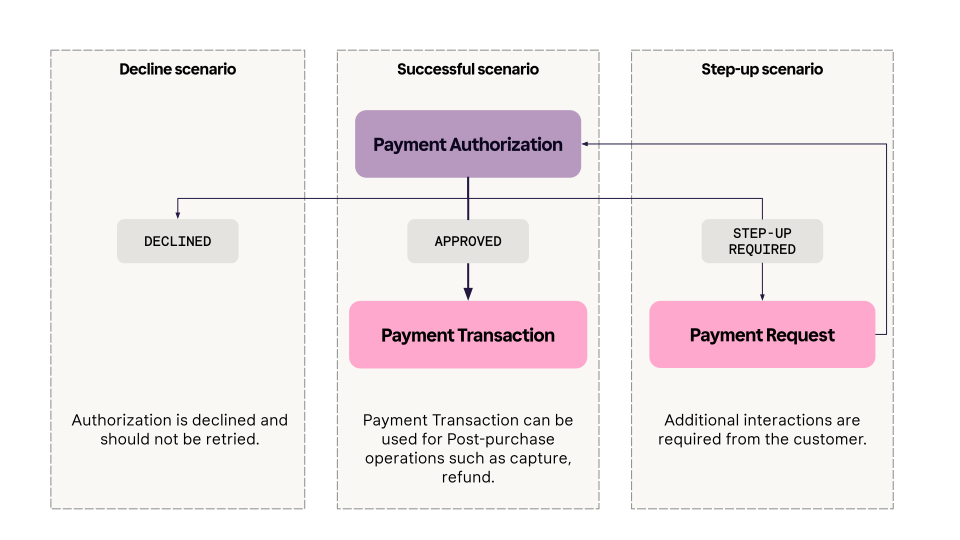
Payment authorization results
The response schema is as follows:
JSON
1
2
3
4
5
6
7
8
9
10
{
  "payment_transaction_response": {
    "result": "STEP_UP_REQUIRED"
  },
  "payment_request": {
    "payment_request_id": "krn:payment:us1:request:552603c0-fe8b-4ab1-[...]",
    "payment_request_reference": "backend-request-ref-12345",
    "amount": 11800,
    "currency": "USD",
"state": "SUBMITTED",Your backend endpoint should handle the different authorization outcomes and communicate the results to your frontend.
Here is an example showing how your frontend can retrieve the results from your backend endpoint
JS
1
2
3
4
5
6
7
8
9
10
// Example Node.js/Express endpoint
app.post('/api/authorize-payment', async (req, res) => {
  try {
    const { klarnaNetworkSessionToken, paymentOptionId } = req.body;

    // Call Klarna Payment Authorize API
    const klarnaResponse = await callKlarnaAuthorizeAPI({
      klarnaNetworkSessionToken,
      paymentOptionId,
amount: 11800,What happens next after step-up
What happens next:
When the frontend receives
STEP_UP_REQUIRED with the paymentRequestUrl, the Klarna Web SDK automatically launches the Klarna Purchase Journey (see Step 5).Acquiring Partners must include return URLs in the to enable the step-up scenario.
step_up_config when calling authorizePayment to enable the step-up scenario.These URLs, set inside the
customer_interaction_config object, tell Klarna where to redirect the customer after they complete or stop the Klarna Purchase Journey.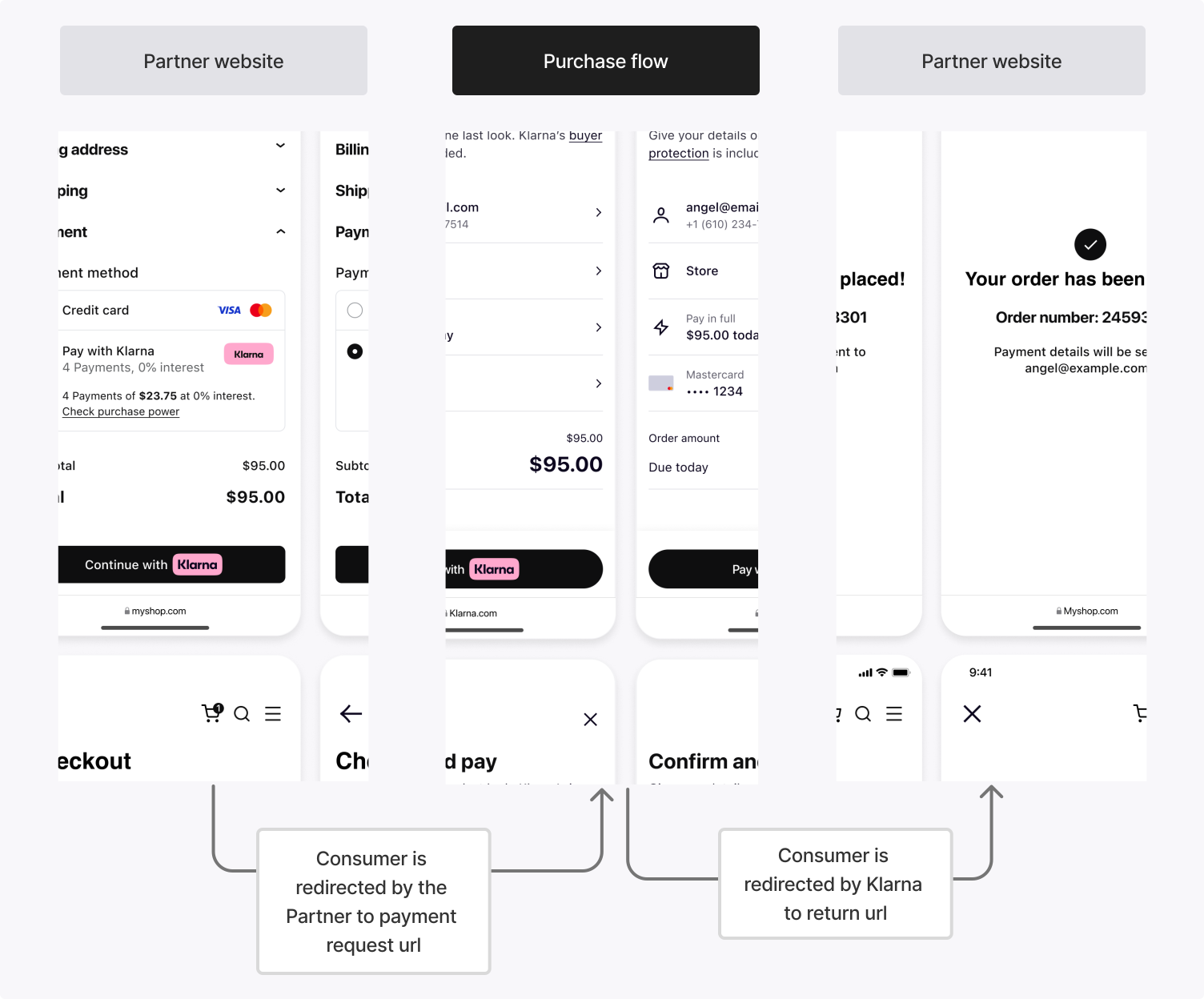
If the Klarna Purchase Journey is launched in a web environment, Klarna redirects the customer to the
return_url after they finish — whether they complete or stop the flow. This can be a URL managed by the Acquiring Partner (which handles redirection logic) or one collected directly from the Partner.On mobile, the customer may be redirected to a third-party app (such as a bank app) or the Klarna app during the Klarna Purchase Journey. The
app_return_url brings the customer back to the Partner's mobile app when this happens.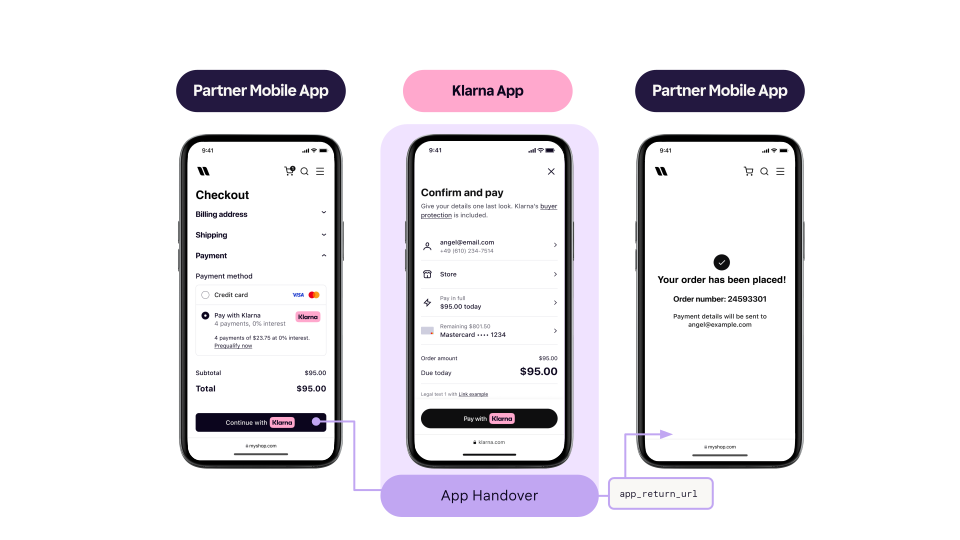
Partners must register a URL scheme (e.g.,
partnerapp://klarna) that resumes the payment flow. Klarna invokes this URL after the customer completes a native app-based step, such as biometric authentication or Klarna app login. Partners are expected to resume the mobile app in its last state without applying state changes or deep link navigations.The
return_url and app_return_url are not mutually exclusive. Depending on the device and environment, either or both may be triggered:| Scenario | Description |
|---|---|
| Pure web flow | The customer starts the Klarna Purchase Journey in a desktop browser. After completing the flow, Klarna redirects them to return_url. |
| App-to-app flow | The Partner's native app opens the Klarna Purchase Journey using a universal link. If the Klarna app is installed, the customer goes directly into it. After completion, Klarna redirects them to app_return_url. |
| WebView flow with app handover | The Partner's native app starts the Klarna Purchase Journey in a System WebView. If the customer must authenticate via an external banking app, app_return_url returns them to the Partner's app mid-flow. They then resume in the WebView and, on completion, are redirected to return_url. |
Avoid duplicate return URL collection
If the Acquiring Partner already collects a suitable
return_url or app_return_url from the Partner, do not request a second one — this would increase the minimum integration requirements for Klarna to work.A step-up occurs when Klarna requires additional customer interaction to complete a Payment Authorization — for example, when the customer needs to log in, authenticate, or select a payment method.
When step-up is triggered, authorizePayment returns a
returns a STEP_UP_REQUIRED result along with a Payment Request containing the payment_request_url which is required for the Klarna Web SDK to launch the Klarna Purchase Journey.The Klarna web SDK launches the Klarna Purchase Journey through the
initiate function on the Klarna Payment button. The function returns a promise that resolves to an object containing the paymentRequestUrl:JAVASCRIPT
1
2
3
4
5
6
7
8
9
10
const buttonConfig = {
  initiate: () => {
    // Call to Payment Authorize API returns STEP_UP_REQUIRED
    return { paymentRequestUrl: "https://pay.test.klarna.com/na/requests/6bbf6775-[...]/start" };
  },
  initiationMode: "DEVICE_BEST", // "DEVICE_BEST" (default) | "ON_PAGE" | "REDIRECT"
};

// Render and mount the button with the assigned configuration
paymentPresentation.paymentButtonThe
initiationMode parameter controls how the Klarna Purchase Journey is launched when your backend returns STEP_UP_REQUIRED. Configure this in your frontend payment button.| initiationMode | Description |
|---|---|
DEVICE_BEST | Automatically selects the best way to launch the Klarna Purchase Journey depending on the device - this is the default and recommended value: *Mobile: Always redirect *Desktop: pop-up if possible, fallback to redirect
|
ON_PAGE | The Klarna Purchase Journey is triggered on the same page. The customer never leaves the page. The Klarna Purchase Journey opens in a pop-up if possible and fallback to fullscreen iframe if necessary. |
REDIRECT | The customer will be redirected to the Klarna Purchase Journey. Note: for this initiationMode, a return_url is required in the customer_interaction_config object when calling the Payment Authorize API. |
When InitiationMode matters
When does this matter? The
initiationMode parameter only affects the customer experience when your backend returns STEP_UP_REQUIRED. If your backend returns APPROVED, the customer proceeds directly to the confirmation page without launching the Klarna Purchase Journey.For complete frontend implementation details, see the Payment Presentation guide.
The Klarna Purchase Journey allows the customer to authenticate with Klarna (via login, one-time passwords, etc.), choose a payment method, and accept the payment.
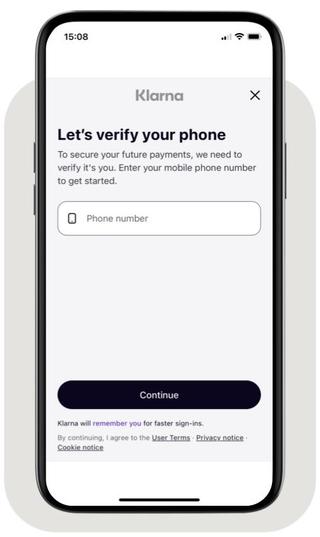
Phone collection in the Klarna Purchase Journey
Klarna redirects the customer to the
return_url in customer_interaction_config, except when a pop-up experience is used and the customer stops the flow.On completion, Klarna issues a
klarna_network_session_token to the Acquiring Partner to finalize the payment.Acquiring Partners can register event handlers on the
KlarnaPayment SDK interface to track Klarna Purchase Journey stages:| Event handler | Purpose |
|---|---|
on("complete", callback) | Triggered when the customer accepts the purchase. During a redirect flow, the handler fires once the success page loads. Pending updates are triggered even if the handler is registered after the page loads, removing the need for polling. |
on("abort", callback) | Triggered when the customer stops the Klarna Purchase Journey. |
on("error", callback) | Triggered when an error occurs during the Payment Request lifecycle. When defined, all errors are emitted to this handler instead of being thrown. |
Event handlers provide access to the following
paymentRequest properties:| Property | Definition |
|---|---|
paymentRequestId | Unique identifier of the Payment Request. |
state | Current state of the Payment Request. |
previousState | Previous state of the Payment Request. |
stateReason | The reason the Payment Request is in its current state. |
stateContext | State-specific context. The klarna_network_session_token is stored here when the Payment Request reaches the COMPLETED state. |
JAVASCRIPT
1
2
3
4
5
6
7
klarna.Payment.on("complete", (paymentRequest) => {
  console.log("Payment request completed");
  // By default, Klarna will redirect to the submitted return_url upon completion.
  // Return false if you want to prevent the redirection to the success page.
  return true
});
Integration requirement
Use Web SDK events to enhance the customer experience — for example, displaying clear error messages when a purchase is stopped, or disabling page interactions while payment authorization is in progress.
Never use SDK events to trigger Payment Authorization. Always rely on Klarna webhooks to receive the
klarna_network_session_token and finalize the payment after the customer approves the purchase.When the authorizePayment API returns
API returns STEP_UP_REQUIRED, the customer needs to complete the Klarna Purchase Journey before you can finalize the authorization. Your backend monitors for step-up completion by the customer to know when to proceed.Once the customer completes the step-up, Klarna issues a new
klarna_network_session_token that you'll need for the finalization call in Step 7.Integration requirement
The
klarna_network_session_token is valid for only 1 hour, so be sure to use it promptly.Subscribe to the
payment.request.state-change.completed webhook event using the guidelines provided here. Klarna sends this event when the Payment Request reaches the COMPLETED state.This event indicates that the customer has finished the step-up interaction and that the Acquiring Partner can proceed with finalizing the authorization.
Sample payload
JSON
1
2
3
4
5
6
7
8
9
10
{
  "metadata": {
    "event_type": "payment.request.state-change.completed",
    "event_id": "d9f9b1a0-5b1a-4b0e-9b0a-9e9b1a0d5b1a",
    "event_version": "v2",
    "occurred_at": "2024-01-01T12:00:00Z",
    "correlation_id": "2d1557e8-17c3-466c-924a-bbc3e91c2a02",
    "subject_account_id": "krn:partner:global:account:test:HGBY07TR",
    "recipient_account_id": "krn:partner:global:account:test:LWT2XJSE",
"product_instance_id": "krn:partner:product:payment:ad71bc48-8a07-4919-[...]",As an alternative method, retrieve the Klarna token(s) by calling the readPaymentRequest API.
API.Once the Payment Request reaches the
COMPLETED state, the token(s) are available in the state_context object of the Payment Request.
Sample payloadJSON
1
2
3
4
5
6
7
8
9
10
{
  "payment_request_id": "krn:payment:us1:request:552603c0-fe8b-4ab1-[...]",
  "state": "COMPLETED",
  "previous_state": "IN_PROGRESS",
  "state_context": {
    "klarna_network_session_token": "krn:network:us1:test:session-token:eyJhbGciOiJIU..."
  },
  "expires_at": "2025-02-26T17:25:34.534721775Z",
  "created_at": "2025-02-24T17:25:34.534721775Z",
"updated_at": "2025-02-24T17:25:34.534721775Z",After receiving the
klarna_network_session_token from webhook or polling, finalize the authorization by calling the Payment Authorize API again with the new token.Call authorizePayment using:
using:- The newly obtained
klarna_network_session_tokenin theKlarna-Network-Session-Tokenrequest header - The same payment context (
amount,currency,supplementary_purchase_data,klarna_network_data) used in the initial authorization - The same
payment_transaction_referenceto link the requests
Example finalization request:
SHELL
1
2
3
4
5
6
7
8
9
10
curl https://api-global.test.klarna.com/v2/accounts/{partner_account_id}/payment/authorize \
  -H 'Authorization: Basic <API key>' \
  -H 'Content-Type: application/json' \
  -H 'Klarna-Network-Session-Token: krn:network:us1:test:session-token:eyJhbGciOiJIU...' \
  -d '{
        "currency": "USD",
        "supplementary_purchase_data": { ... },
        "klarna_network_data": "{\"content_type\":\"vnd.klarna.network-data.v2+json\",\"content\":{\"operation\":\"payment_request\",\"request\":{\"supplementary_purchase_data\":{...}}}",
        "request_payment_transaction": {
"amount": 11800,Integration requirement
If the
klarna_network_session_token has expired (1-hour validity) or the payment context doesn't match the initial authorization, the finalization call returns DECLINED.When finalization succeeds, Klarna returns
APPROVED with the payment transaction:JSON
1
2
3
4
5
6
7
8
9
10
{
  "payment_transaction_response": {
    "result": "APPROVED",
    "payment_transaction": {
      "payment_transaction_id": "krn:payment:us1:transaction:791bbb7b-813a-[...]",
      "amount": 11800,
      "currency": "USD",
      "payment_pricing": {...},
      "payment_funding": {
"type": "GUARANTEED",Map the Klarna authorization result to the Partner-facing API response:
klarna_network_response_data
Requirements
- Treat this value as an opaque string; do not validate or infer its structure.
- Use exact parameter name
klarna_network_response_datain the Partner-facing API to ensure Partners can easily identify and use the parameter - All returned data MUST be forwarded without modification. Below is an example of how Acquiring Partners can return the Klarna Network Response Data parameter in their Partner-facing APIs.
JSON
1
2
3
4
5
6
7
8
9
10
{
  "checkout_id": "cs_27234RBQD9NAKD032BN",
  "amount": 17800,
  "status": "completed",
  "currency": "USD",
  "additional_data": {
    "klarna_network_response_data": "{\"content_type\":\"vnd.klarna.network-data.v2+json\",\"content\":{\"operation\":\"payment_request\",\"response\":{\"result\":\"APPROVED\",\"payment_transaction\":{\"payment_transaction_id\":\"krn:payment:us1:transaction:791bbb7b-813a-[...]\"}}}}"
  }
}
After implementing the backend authorization endpoint, complete your integration:
- Manage payment transactions - Capture, refund, and cancel authorized payments
Jump to section...